• RSS
  • Design and Simulation:These are some books which are recommended as a reading list. 1- Aerodynamics of Road Vehicles from Fluid Mechanics to Vehicle Engineering. Edited by Wolf-Heinrich Hucho 2- Hucho-Aerodynamik des Automobils Stromungsmechanik.Warmetechnik. Fahrdynamiik.Komfort
  • Optimizing Performance and Fuel Economy of a Dual-Clutch Transmission Powertrain with Model-Based Design.
  • Wind Turbine DesignPrimary objective in wind turbine design is to maximize the aerodynamic efficiency, or power extracted from the wind. But this objective should be met by well satisfying mechanical strength criteria and economical aspects. In this video we will see impact of number of blades, blade shape, blade length and tower height on wind turbine design.
  • Modelling Complex Mechanical Structures with SimMechanicsModeling physical components or systems in Simulink® typically involves a tradeoff between simulation speed and model fidelity or complexity: the higher the fidelity of the model, the greater the effort needed to create it..
  • Biomass Energy Vs. Natural GasIn 2009, natural gas prices plunged to below $4 per MMBtu where many "Experts" are saying that prices will remain low for decades as a result of technology break-throughs allowing for sizable increases in natural gas supply for North America. The Energy Information Agency (EIA) just released data projections reflecting this potential increased supply in natural gas.

Tuesday, 4 February 2014

What Greens "Don't Get" about the Republican War on Global Warming.

Posted by Sohail Azad On 14:43

Note: Today's blog uses the term "Greens" as those who believe human actions (anthropogenic) of burning fossil fuels is the primary driver in Climate Change.

In messaging to shape public opinion, Greens constantly agonize over the lack of understanding and denial of science by Conservatives -- and target this "knowledge problem" as the major obstacle in achieving Green policies. But in reality, its Greens who are not very "street smart" in their approach to both opposition and connecting with most Americans.
Conservatives Are Much Smarter Than Greens Think.

The Big Question: In the Greens' World, there is a yes/no big question that everyone must answer, "Is Global Warming caused by humans?" It defines who you are -- as either a carbon tax loving Warmist, or a science ignorant Denier. But as public opinion polls are reflecting, Greens need to ask themselves a Big Question: Don't they need to do a better job in their message and messaging?

Latest Pew Research Poll Results: While over two-thirds of Americans believe the Earth is warming, only 44% are buying into the Greens' Argument that it's mostly caused by human activity (anthropogenic). Even among the strongest group of Greens supporters, about one-third of Democrats are unconvinced. Clearly public acceptance problems exist with the Greens' science message and their "people skills" in connecting -- as the majority of Americans share uncertainty, doubt, or skepticism as voiced by Conservatives.

Greens need to abandon their Ivory Towers and messaging that's far too often patronizing, apocalyptic, and plays the "guilt card". Better resonating science and economic messages must be developed with messengers who are good teachers and bridge builders. Greens also need to be much more adept in responding to both ideological opposition by Conservatives and the hidden agendas of Republican policies when driven by big-business.

A Good Starting Place for Greens -- Stop Stereotyping: Greens' characterization of Conservatives as comic dimwits is both incorrect and counterproductive. As numerous social science studies and poll research show, Conservatives have general science knowledge equal to, or exceeding other politically affiliated groups. In fact, one recent research study found that with increasing levels of scientific literacy, even more partisan polarization occurs over Global Warming.

Take the Pew Research Quiz on Science and Technology to see where your general knowledge ranks compared to the U.S. Public.

But stopping stereotyping is more than just about about fair play -- its about "people skills" with the Greens' Target Market. Negative labeling hurts efforts to connect with Independents, Moderates, and even one-third of Democrats by sending a wrong message: If you disagree or have doubts with the Greens' Argument, you must be ignorant. Patronizing name-calling only alienates and does not win people over, as the Pew Poll is reflecting.

Greens must understand the difference between ideological opposition versus fair questions over science uncertainty, especially the perceived urgency to act (e.g., predictive ability of climate models).

A Major Obstacle & Need For Bridge Building: Contrary to the ubiquitous negative messaging by Greens, science knowledge really isn't the key problem in achieving greater public acceptance. A major problem is the current and growing polarization in "cultural values ideology" between Red State (Conservatives) versus Blue State (Liberals). When issues are strictly defined or framed in terms of ideological values such as Good versus Evil, the results are toxic. There can be no real public dialogue, people of differing views are demonized, and finding common ground is impossible.

When differences are defined
in terms of moral values,
compromise is impossible.
The key in solving any problem
is to find common ground
between differing views.

After decades of negative ideological "values" messaging on environmental issues from Conservative Think Tanks, Media Sources, and Religious Groups, it's now just a reflex knee-jerk reaction for Conservatives (with spillover to Moderates and Independents) to associate and demonize almost any environmental policy initiative as big-government, socialism, anti-free markets, job loss, and sadly even with Faith (worshiping the Green Dragon).

When Exxon/Mobil is a major cash contributor to conservative religious groups to fight Global Warming as satanic -- you know some serious "culture wars" are going on.

The result of this negative messaging is clearly evident in national polling, where partisan divides on environmental issues are greater than on major issues like the budget deficit, health care, Social Security, etc.

Widest Partisan Differences Over Issues
(% rating each a top priority)
Issue:
Rep
Dem
Ind
Diff
Protecting the Environment:
28%
65%
48%
-37%
Problems of Poor & Needy:
32%
64%
48%
-32%
Reducing U.S. Budget Deficit:
80%
49%
66%
-31%
Dealing with Global Warming:
14%
42%
27%
-28%

This extremely negative mindset on environmental issues can explain why over 40% of Tea Party Republicans and 25% of all Republicans (per Pew Polling) believe Global Warming is not even happening.

The consequences of this cultural divide results in very different perspectives in how Global Warming is presented and viewed in the public arena. Where science is the driver for the Greens' messengers, ideological values (effecting policy outcomes) are the drivers for Conservatives.
As Viewed by
Greens
As Viewed by Conservatives

This difference in perspective creates a serious dilemma for Greens -- as it's virtually impossible to discuss Climate Change as a stand-alone science issue. Any argument that human actions are primarily causing Climate Change is intrinsically linked to specific policy outcomes. The most prevalent example is a carbon tax, which will have opposition across partisan, cultural, and socioeconomic lines (e.g., with lower income groups as a regressive tax).

Playing by the Conservatives' Rules: Greens need to fully grasp the importance of ideological motivation in forming public opinion -- emphasizing their own positive set of values that can cross partisan divides and achieve key objectives. By messaging positive ideological values better, they may even find some surprising new friends.

Bridge Building to Find & Develop Common Ground

A recent New York Times article illustrates the incredible potential of connecting on ideological values -- where Greens and Conservative Libertarians (the most negative partisan faction opposing Climate Change policies) have found common ground in support of solar energy.

Recognizing Hidden Agendas: In addition to addressing climate science uncertainty and ideological conflicts better, Greens also need to improve their messaging to a third type of opposition. For decades, Republican Strategists have used environmental issues to divert public attention from hidden objectives of big-business special interests. When issues can be framed in a context of "The Environment versus Job Loss/Higher Costs", Republican policy-makers can avoid public opinion scrutiny and answering hard questions that can have nothing to do with the environment.

By achieving this "Framing", Republicans are given a free pass (or certainly less public questioning) on whether their proposed policies are in the best interests of average Americans (regardless of environmental issues) and if these policies truly "walk the talk" on conservative or libertarian values.

The Keystone pipeline project is a perfect illustration of this Republican strategy, where we now (or should) know what Keystone was originally always about -- exporting U.S. oil to foreign markets (like energy hungry China):

With record growth in U.S. oil production, Republican and Oil State politicians, big business leaders, and oil lobbyists are all calling to end a nearly 40 year ban on U.S. crude oil exports. The ban was put into place in the wake of the 1973 OPEC Oil Embargo.

The Issue of Republican Trust: During the coming year, there will be much debate over whether lifting the oil export ban is good policy. But in this public debate there is something even more important to Greens than Global Warming. It about the bedrock of public opinion -- the issue of Trust and if Republican messengers can be trusted:

Where on the cusp of likely Keystone approval, the Republican narrative to the American Public on why Keystone was important has now completely changed.

In the 2012 Presidential Campaign, Keystone was the "Poster Child" of conflict between Environmentalists and Republicans over energy issues. Less than a year ago in the debt ceiling debacle in Congress, Republicans threatened to shut the Federal Government down unless President Obama approved Keystone.

Republican Messaging
to the U.S. Public:
Hidden Agenda
Policy Objective:
In our next follow-up Blog, we will look at the three key building blocks of past Republican messaging of why Keystone was needed -- and how ending the oil export ban is a 180� about-face to Keystone's original arguments.

Facebook:

Additional Stories:
When Religion and Science Collide (N.Y. Times)
Scare Tactics not moving U.S. Public Opinion

Sunday, 5 January 2014

Where does U.S. Gasoline come from?

Posted by Sohail Azad On 07:49

Per the U.S. Department of Energy:
  • 69% of the pump price of gas is crude oil cost which equals $2.24 per gallon.
  • 60% of crude oil is from domestic sources and 40% comes from imports:
  • Domestic Oil:$1.34(60%)
    Imported Oil:$0.90(40%)
    Cost Per Gallon$2.24

    (Note: Crude oil cost of $2.24 per gallon is equal to 59� per litre or �.43 per litre.)

    The following two charts show where this oil comes from in U.S. gasoline:
  • The significance of Texas region (TX, NM, LA) in U.S. oil production.
  • That the "Non Free Trade Cartel" of OPEC is a larger supplier of
        imported oil than Canada.
  • Origin of Oil in U.S. Gasoline Supply
    (Bar Chart Perspective)
    Origin of Oil in U.S. Gasoline Supply
    (Bubble Chart Perspective)
    Notes on Domestic Production: Total U.S. oil production (with record growth during the past two years) has now increased 50% since 2008. Through the extensive use of fracking and horizontal drilling, almost all of this growth is occurring in six U.S. tight oil formation regions -- especially in the Texas region (TX, NM, LA) and North Dakota:

    U.S. Oil Production Growth Regions
    As discussed in our last blog, the production cost of extracting oil from fracking/horizontal drilling is very expensive -- up to 4 to 6 times higher than from conventional oil fields in the Middle East. Without a continuance of high market prices for crude oil (currently $107/bbl for Brent, $95/bbl for WTI) much of this U.S. oil would be uneconomic to extract.

    Notes on Foreign Oil Sources: A common misconception in public opinion is that the OPEC Cartel represents only countries from the Middle East. OPEC members also include countries in Africa and South America. The OPEC member of Venezuela (the 4th leading oil importer to the U.S.) is very "oil hostile" -- and has nationalized and continues to seize U.S. Oil Companies' assets.
    OPEC Oil Imports to U.S

    Following The Money Trail: As stated earlier, 69% of the pump price of gasoline is crude oil cost -- which currently equals $2.24 per gallon. The next chart breaks down where and how much of your money is going every time you fill up.
    One thing that should pique/grab American consumers' attention is just how much of their gasoline dollars are going to the "non free trade cartel" of OPEC and other "questionably friendly" foreign countries (like Russia).

    Where U.S. Gasoline Money For Oil Goes:
    (per gallon)
    When a Politician or "Talking Head" attacks renewable energy (especially biofuels) with the ideological statement "The free market should determine energy winners and losers, not big-government" -- everyone should think about something:

    Every time we fill up our tank, consumers have "no choice" but to send 36� per gallon to OPEC (about $220 a year for an average driver). This is the equivalent to a "mandate" that 16% of the U.S. gasoline supply be blended with OPEC oil. This is anything but a "Free Market".

    Related News Stories:
    Ethanol and U.S. Foreign Oil Dependence

    Thursday, 26 December 2013

    Spin Doctors on U.S. Oil Production, Costs, and Energy Policy.

    Posted by Sohail Azad On 19:25

    Spin Doctor: A person (such as a "Talking Head") who tries to control the way something is described to influence public opinion in a way that helps their side and hurts (often demonizing) differing views. "Spinning" always contains some elements of truth to enhance credibility, but conveniently overlooks/dismisses any facts not helpful in forming the desired public perception.

    Current Status of U.S. Foreign Oil Dependency: Over the past 7 years, the amount of oil supplied from foreign sources has decreased from an all-time record peak of 60% in 2005 to currently ~40%. While lower oil consumption (resulting from economic recession, greater auto efficiency) has played a part, this amazing (and hopefully sustainable) achievement has been primarily the result of technology advancements in oil extraction.

    Per the U.S. Energy Information Agency's (EIA) long-term forecast, foreign oil use is expected to decline even further (with an estimated 32% from oil imports by 2040).

    Through the extensive use of fracking and horizontal drilling, almost all of this domestic growth in oil and natural gas production is occurring in six U.S. regions:

    History of U.S. Oil Production
    & Consumption:
    Increased U.S. Oil Production Growth Regions

    What Spin Doctors Don't Tell Us On U.S. Foreign Oil Dependency: In this renaissance of U.S. oil production, one often hears the sound-bites of "Energy Independence", "Freedom from Mid-Eastern Oil", "Canada is now America's #1 Oil Importer". The problem with these now generally held public perceptions is that they don't exactly tell the full story.

    While it is correct that Canada is now the "single country" largest exporter of oil to the U.S., the Mid-east dominated oil cartel of OPEC (which includes a very oil-hostile Venezuela) remains America's largest supplier of foreign oil.

    Putting the above chart into a global perspective, OPEC oil consumed in the U.S. is more (or about equal in the case of Japan) than the "total" amount of oil consumed in other leading industrialized nations:

    U.S. OPEC Oil Imports Versus
    Total Oil Consumed in Other Nations
    Understanding the massive U.S. appetite for oil is pretty simple -- the American "love affair" with cars. Compared to the rest of the world, the U.S. remains hopelessly addicted to gasoline. Americans (per capita/person) consume more than 300 gallons of gasoline per year, which is by far the highest among 128 countries. That's more than three Germans, or ~7 people in France.

    Use of Cherry-Picking Ideological Arguments: Perhaps the most hypocritical example of selective cherry-picking by "Spin Doctors" is the commonly used "sound-bite": "Free Markets should determine energy winners and losers, not big-government".

    The following graph (using EIA data) breaks out the individual components of current pump gas prices -- where U.S. consumers currently "have no choice" but to pay 37� per gallon to OPEC for crude oil costs.1

    From an ideological argument perspective, this is the equivalent of a mandate that 16% of all gasoline be blended with OPEC oil. 2

    Components of Gas Pump Price
    (U.S. average of $3.34 per gallon @ November 2013)

    1 69% of the current pump price of gasoline is crude oil costs ($2.30 per gallon). 40% of all crude oil is from foreign sources (92�). 40% of foreign oil is from OPEC (37�).
    2 40% of all oil consumed is from foreign sources and 40% of foreign oil is from OPEC (40% times 40% equals 16%.)

    OPEC is anything but "free market trade" -- a cartel that manipulates markets, restricts output and fixes prices that's had a devastating effect on the U.S. economy. But OPEC's reach is beyond just its Middle-East members, where Venezuela has nationalized and continues to seize U.S. Oil Companies' assets.

    What The Spin Doctors Don't Tell Us On Economics: The message of "Drill, Baby, Drill" has mass public perception appeal of basic supply/demand economics that even a caveman can understand. It's just common sense that if U.S. oil production increases (by removing "big-government" barriers) that gasoline prices at the pump will decrease -- Right? Well, not exactly.

    An inconvenient fact is that extracting oil using fracking and horizontal drilling technology has dramatically higher costs than in typical Middle East oilfields. According to Oil Analysts, the average cost of new oil production from U.S. tight oil and shale gas regions is ~$70 a barrel, with marginal costs (the last barrels produced) as high as $114 a barrel in 2012.1, 2, 3

    Conversely, for conventional oil output in the Middle East, average production costs are just over $20 a barrel , with marginal costs at ~$30 per barrel.

    World-Wide Marginal Production Cost of Oil

    While there are numerous economic benefits in developing domestic energy resources (e.g., job creation, economic development, reducing the massive U.S. Trade Deficit) -- expectations of significantly lowering the "current" price of crude oil isn't one of them. Simply stated, because of the high extraction costs of advanced technologies, increased U.S. oil production is totally dependent on maintaining high oil market prices.

    In order to achieve claims made by "Spin Doctors" for a return to $2 gasoline by increasing U.S. oil production would require a precipitous price drop to ~$40 a barrel (bbl) -- a market price significantly below either the average (~$70/bbl) or marginal (~$110/bbl) costs to extract oil using fracking/horizontal and deep-sea drilling.

    We Need to have a "Real" Energy Policy Debate: In order to have a meaningful dialog everyone needs to pause, take a deep breath, and move away from the extreme polarization that partisan "Spin Doctors" create. Energy policy shouldn't be limited to "Red State vs. Blue State" tunnel vision on any one specific "hot button" issue (ranging from Conservatives mistrust of big government to Environmentalists' adamancy? on Climate Change).

    It's about addressing a myriad of problems and trying to solve them -- compromising and finding common interests in a bigger picture rather than focusing on things that divide us.

    Overlapping Issues with Energy Policies:

    Additional News Stories:
    In U.S. Public Opinion Polls, Saudi Arabia is viewed very unfavorably.
    Record Growth in U.S. Oil Production.
    Global Oil Prices and Energy Security
    Fact Check on Keystone Pipeline Claims

    Wednesday, 27 November 2013

    Where Obama Is Wrong on Coal

    Posted by Sohail Azad On 11:53

    Update! While Environmental Organizations are outraged, the recent Budget Bill in Congress rescinded the Obama Administration's banning of the Export-Import Bank to finance any coal power plants.

    Coal Use in Developing Countries: As part of it's policy initiatives to reduce global carbon emissions, the U.S. is ending support for new coal-fired plants around the world. Except in "rare" situations of poverty (whatever that means), the U.S. will no longer contribute to coal projects financed by the World Bank and other international development banks.

    Like other top-down attempts by governments to control carbon emissions (taxes, treaties), this U.S. "no new coal" policy uses an incorrect paradigm, and will not result in meaningful and needed global reductions.

    A correct approach must always balance present humanitarian and economic needs with long-term climate science objectives -- utilizing a bottom-up model, tailored to provide multiple pathways to develop and sustain individual economies with needed lower carbon standards.

    The Other Inconvenient Truth: While the below facts are on India (EIA data), these harsh realities are found throughout the developing world where poverty is common, not rare (e.g., India, Asia, Indonesia, Africa).

    India suffers from severe shortages of electricity, where only 60% of rural households have access to electricity.

    Rural areas rely on traditional biomass for cooking, heating, and lighting because they lack access to other energy supplies.

    The biomass used in "open burning" is 62.5% from firewood, 12.3% from agricultural wastes, and 12.3% from animal dung.

    Nearly one-fifth of today�s global population � 1.2 billion people � lives without access to electricity. Two-fifths of the population � 2.8 billion people � still relies on solid fuel such as wood, charcoal, cow dung, and coal in low-tech cooking and heating.

    Often, it seems as though Industrialized Nations and Environmental Organizations become so overwhelmed by the specifics of Climate Change science (e.g., CO2 PPM) that they lose focus on people -- where 35% of the Earth's population (2.5 billion people) don�t even have access to a basic human need of having a toilet.

    A correct paradigm recognizes that reducing global carbon emissions is intrinsically linked to reducing world poverty. Addressing this just isn't about industrialized countries providing direct financial aid, but includes issues such as international trade and technology transfers to developing countries.

    Size of World If Scaled by Poverty:
    (43% of the world population lives on $2 a day or less.)

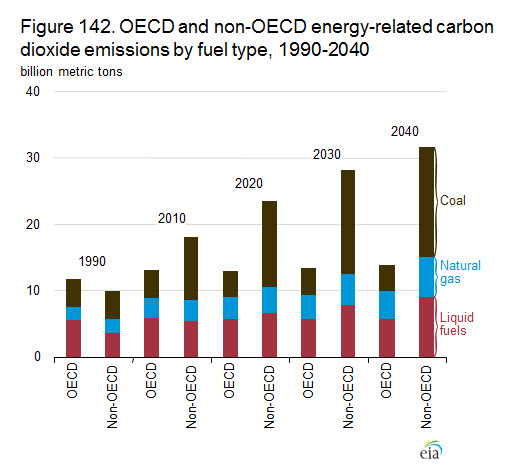
    World Coal Use: In writing this blog, the issue of "tone" is always important. Criticism of the U.S. No-Coal Policy is not saying that world coal use isn't a major concern (where 43% of current CO2 emissions from fuel combustion are from coal). The problem is the rigidity of a "One Size Fits All" Policy for every developing economy.

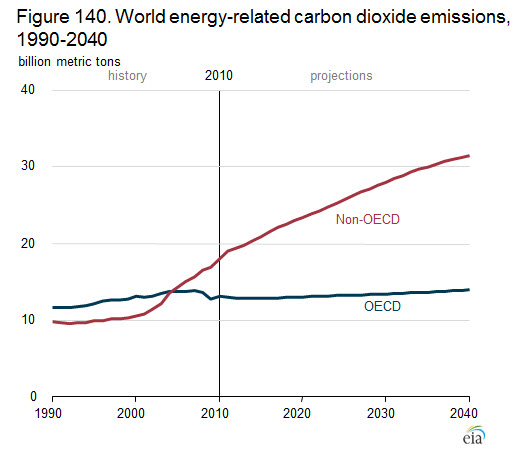
    A chart from the latest U.S. Department of Energy's (EIA) International Energy Outlook to 2040 illustrates this point.

    The future global Climate Change problem with coal use is overwhelmingly from China, not "all" developing countries.

    For example, while coal use in India and the U.S. is projected to be approximately equal, India has 4 times the U.S. population (~1.2 billion versus ~300 million people) -- resulting in much lower emissions per-capita (per person).

    Carbon Emissions Per Capita: The disparity in carbon emissions per-capita between industrialized countries versus developing economies has and will continue to be a major stumbling block in achieving any consensus on needed global actions.

    In the U.S., carbon emissions are currently over 19 tons per person -- a consumption rate over 17 times that of India (~1 ton per person).

    Can International Treaties Ever Work?: At the latest U.N. sponsored conference on Climate Change in Warsaw, three events continue to raise "red flags" on the potential effectiveness of making international treaties the "centerpiece" in efforts to reduce global carbon emissions.

    (1) The Double Standard Argument: There is increasing skepticism whether "any" meaningful agreement between industrialized and developing countries can ever be reached. Brazil's recent proposal (supported by 130 developing countries) would use carbon emission levels dating back to the industrial revolution to set limits on future emissions. Not surprisingly, the U.S. and EU rejected this proposal.

    (Nations Scaled By Cumulative Emissions)
    Developing countries argue that because Western industrialized nations have been emitting tremendous volumes of greenhouse gases for over 200 years, they must bear the most responsibility to rein in greenhouse gas emissions.

    (2) Can Treaties Really Ever Be Binding?: Japan (the world's fifth largest greenhouse gas emitter) announced a scale-back in its plans to reduce carbon emissions from 25% to just 3.8% (which is actually a ~3% increase from 1990 levels). While Japan's action is certainly understandable resulting from the 2011 tsunami and earthquakes -- this raises a question whether any international treaty could ever be truly binding. Exceptions, ranging from natural disasters (as again recently demonstrated in the Philippines with typhoon Haiyan) to economic hardships will always be present.

    (3) Money, Money, Money: As in prior Climate Change conferences, the critical issue of "who pays for necessary actions" was again never seriously addressed (with political reality). The general number tossed around is needed financial support (direct aid, loan guarantees) from industrialized to developing countries of $100 (�73) billion per year.

    When Rigid Ideologies Drive Policy: While most environmental groups are applauding this U.S. "no new coal" policy, both they and the Obama Administration are wrong in the paradigm they have created. This policy action is yet another example of the rigid ideological polarization that divides America on so many things today -- where issues are routinely defined (and demonized) in terms of a black-or-white (either/or) paradigm with no gray area that could lead to positive and productive compromise.

    The U.S. "no new coal" policy exemplifies this polarization of black/white ideology in solving complex problems. While coal use is clearly a problem, it isn't "the only major" problem. Not only is this U.S. Policy position laden with hypocrisy (coal use per capita in the U.S. economy), it defies the reality that coal will continue to be a major energy resource in the developing world.

    Size of World if Scaled by Coal Use:
    A constructive approach is how to make coal use more efficient, where a multitude of technology options exist. Especially in manufacturing, production efficiency gains can be much more than marginal improvements.

    (No unilateral U.S. action will achieve major global reductions in coal use.)
    (A "My Way or the Highway" approach
    isn't pragmatic or productive.)

    The Case For Different Pathways: Perhaps the best illustration of providing flexibility through "multiple pathways" to lower carbon emissions is Germany, which is:
    -- Dramatically transitioning their energy sector to renewable energy.
    -- Investing heavily in energy efficiency ("Smart Grid" infrastructure).
    -- Achieving high economic growth.
    -- Sizeably reducing carbon emissions
    -- Also bringing new coal-fired generation on-line.

    Germany's share of electricity produced from renewables has increased from 6.3% to over 25% since 2000. Relative to 1990, Germany has also reduced its carbon emissions by 25%.

    However, contradictory to the U.S. "no new coal policy", Germany is currently implementing its biggest new-build program for coal stations in over a decade -- increasing its coal-fired generation capacity by 33%.


    Is this a picture of a vase or two
    people looking at each other, or both?
    The Need For A Mental Reboot: Just because a view doesn't "fit" or "appears" contradictory to a established paradigm/model doesn't necessarily mean its wrong. There's usually always more than just one way in viewing and solving complex problems.

    The goal is to achieve a productive "end-result" -- not ideologically pure ways (e.g., no new coal) of how to get there.

    Moving Forward: To achieve meaningful and sustainable reductions in global carbon emissions a major "paradigm shift" is needed -- moving away from rigid black/white ideologies (which the U.S. no coal policy represents) to a lower carbon standard (LCS) model (a comprehensive approach as being used in Germany).

    As stated in previous blogs, it is strongly believed that international trade should be the centerpiece of this new paradigm. A good starting point is to create the equivalent of "Enterprise Zones" within developing countries (especially free markets economies of India and Indonesia) providing: (1) significant and unprecedented new trade incentives into U.S. and European markets for manufactured products using a "Low Carbon Standard" (LCS); (2) Significant transfers (including financial assistance and less restrictive patent protection) of advanced energy and manufacturing technology into these Enterprise Zones.

    Sometimes the pathway in developing countries may look like what has been accomplished in Western Industrialized Economies -- sometimes it may not. Most often, a LCS pathway in developing economies will require a "bridge approach" (with definitive benchmarks that must be achieved to keep new trade incentives) in transforming to the LCS objective.

    An example of needing a "bridge approach" is the argument that scaling up renewable energy technologies (intermittent wind, solar) have been demonstrated to be competitive with base load fossil fuel generation. What this argument fails to mention is that this competitiveness is highly dependent on having an advanced large (national, regional) transmission "Smart Grid" (which does not yet exist in developing countries).

    Liberal versus Conservative?: Only by using bedrock conservative principles of de-centralization and free markets will the prize of sustainable reductions in carbon emissions be attained.

    Facebook:

    Additional Stories:
    In War on Coal, Coal is Winning (C.S. Monitor)
    Kenya postpones Wind and Solar Energy Projects because of high costs.
    Geothermal energy crippled in Philippines from Typhoon Haiyan.
    World Coal Consumption To Surpass Oil By 2020
    NY Times Op/Ed: Coal use in developing countries
    More opinions on poverty and coal use in developing countries
    Trade/Climate Change Policy: U.S. Liquid Natural Gas Exports?
    U.S. Hypocrisy to Undermine EU LCS Standards on Tar Sands Exports
    Public Opinion Polls: Views on Global Warming -- U.S. Versus World
    Germany set records in coal use.
    Wall St. Investment Firm Backs Away From Major Coal Export Project
    Solar and Wind Vs. Coal in South Africa
    U.S. Regulators Struggle on Writing New Coal Regulations
    Climate Change Can't Be Solved on Backs of the World's Poor.

    JGHG5CK4C5MZ

    Sunday, 3 November 2013

    Global Warming & International Trade -- the Elephant in the Room.

    Posted by Sohail Azad On 19:11

    Update! In a new Stanford University Survey a majority of Americans believe man-made Global Warming is occurring, but do not support a Carbon Tax.

    The Global Greenhouse Gas Conundrum: In BP's Annual Energy Outlook to 2030, World carbon emissions from energy use are projected to increase by 26% by 2030. This increase will primarily come from developing countries (e.g., China, India) as they industrialize their economies (as Western economies did during their Industrial Revolution, called the Kuznets Curve).

    The primary fuel source for powering Asian industrialization will be their vast natural resources of coal, where coal prices are currently about one-third of Liquefied Natural Gas (LNG) and about half of natural gas.

    The biggest carbon emitters among developing nations have made clear that while they are prepared to improve the energy efficiencies of their economies, they have no interest in capping carbon emissions that restrict economic development.

    The Politics of Climate Science in U.S.: Many Conservatives twist valid science uncertainties of Climate Change/Global Warming (e.g., Dr. Judith Curry) to become "Deniers" -- arguing that no economic policy actions (e.g., Carbon Tax) are needed. Conversely, Liberals often use a message of apocalyptic doom/gloom to advance climate policy actions. But for most Moderates/Centralists, they just don't "easily fit" in either of these highly polarized groups.

    Question: What happens if you (A) Believe in the science of Global Warming, but (B) Disagree with a U.S. Carbon Tax Policy?

    Answer: You find yourself in the middle of Red State vs. Blue State, Conservative vs. Liberal, Culture and Political Ideology Wars.

    The Mind of "Sympathetic Greens": While Moderates/Centralists are concerned about Climate Change, a major roadblock in their supporting U.S. policy actions is the conundrum of carbon emissions from industrialization in the World's developing economies. These "Sympathetic Greens" recognize a fundamental reality: The U.S. alone (or even the developed world as a whole) can not reduce global CO2 concentrations. Unilateral U.S. actions may be admirable (lead by example), but are quixotic.

    While a Carbon Tax would undeniably reduce energy consumption in the U.S. (especially among poorer Americans as a regressive tax), how would this impact total Global emission levels? Could an unintended outcome be even more "outsourcing" of greenhouse gas emissions from the U.S. to developing countries? (increasing the already huge U.S. Trade Deficit). Liberals never really address these type questions.

    Growth Rates in CO2 Emissions
    A New Path: A Policy option that just might get us out of this ideological mess and also actually achieve meaningful reductions in global greenhouse gas emissions is by thinking "outside the current box" -- Using international trade agreements between the U.S./EU and developing countries.

    The below chart illustrates the global CO2 impact of international trade where the flow of emissions are allocated to the locations where global goods and services are produced and then consumed -- where Chinese exports to the U.S. and the EU clearly dominate.

    Major Global Flows of CO2 From Production to Consumption:
    Start of Arrow: Fossil Fuel Consumption (Production)
    End of Arrow: Goods and Services Consumption

    Responsibility of the U.S. and EU: To be successful, using international trade to sizably reduce Global CO2 emissions must be a constructive two-way-street with shared responsibility and recognizable benefits -- not driven by parochial interests leading to confrontation (use of free/liberalized trade agreements versus unilateral tariffs/sanctions resulting in trade wars).

    As the World's largest economies, Western industrialized countries must recognize, accept, and act on their unique responsibility:

    Since a significant percentage of CO2 emissions likely remains in Earth's atmosphere for thousands of years, the bulk (perhaps up to 80%) of current CO2 PPM levels (with a man-made footprint) comes from Western industrialization which began in the 18th century.
    Underlying Principle of Free Trade: The U.S. has advocated free-trade policies for decades, but it also has spent considerable effort and diplomatic capital in creating both global and regional trade rules/standards (WTO, NAFTA) -- based on the acceptance and implementation of trade policies by other members (with verifiable actions).

    If Climate Change is to be truly treated as serious on a global stage, pragmatic lessons must be drawn from international trade -- where reciprocity reigns supreme. No country eliminates its trade barriers without reciprocal and meaningful concessions from trading partners.

    Its ironic that ultimate success in addressing Climate Change will depend as much on social sciences of "human nature" rather than just the physical sciences in resolving climate uncertainties. A good analogy is why young people still smoke, given the overwhelming medical evidence that it's harmful -- The difficulty of making a lifestyle change today to avoid the consequences in 20, 30, 40 years. People also need near-term positive incentives -- like wanting to go out with that "Hot Girl or Guy" who only dates non-smokers.

    International Trade Incentives: As the World's largest economies, the U.S. and EU have the ability, opportunity, and responsibility to provide needed positive incentives to developing countries. An illustration of a "concept framework" of trade incentives is California's Low Carbon Fuel Standard.

    Applied to international trade, specific products from developing countries meeting a "Low Carbon Standard" (LCS) would be given greater/favored trade access into U.S./EU markets (achieving a competitive advantage over other countries that don't participate in LCS Free/Liberalized Trade).

    Correcting a Major Policy Mistake on Climate Change: After the Kyoto Protocol in the late 1990's, a major policy error was the missed opportunity to create "Idea Incubators" with developing countries in existing Free Trade areas (especially India and the Philippines). Such an effort could have created "Success Stories", developing and demonstrating a "Model" for specific multi-lateral trade actions and collaborative cooperation (Western technology transfers and financial assistance) that could be then scaled up to sizably reduce CO2 emissions in developing countries.

    It's not too late to correct this mistake, it just will take political resolve by Western industrialized nations to do not just the "right thing as to responsibility" but the "smart thing".

    Multi-Lateral Free Trade Areas
    (Below Countries in Red)
    The following is a conceptual framework of beneficial trade reciprocity between industrialized and developing countries (Wins/Wins) to reduce global CO2 emissions.

    Industrialized Nations

    High Tech Energy Efficient Goods and Services

    (Including U.S. natural gas exports)

    Developing Economies

    "Low Carbon Standard" Products

    (With favored US/EU Trade Status)

    Facebook:

    Additional News Stories:
    Views on Global Trade by Country -- (Pew Research).
    In War on Coal, Coal is Winning (C.S. Monitor)
    China's Coal Demand Set to Double.
    Emerging Economies Nearing One-Half of Global CO2 Emissions.
    Argument that U.S. Carbon Tax Would Have Minimal Impact (0.1�C ).
    Dramatic Decrease in Carbon Intensity in U.S. Economy
    Why A Carbon Tax Will Not Work -- and What Will.
    U.S. to Help Ukraine with Natural Gas Development

    JGHG5CK4C5MZ

    Monday, 21 October 2013

    The Past, Present, and Future of Ethanol

    Posted by Sohail Azad On 14:07

    In our last 2 blogs, the past to the present of ethanol is discussed -- looking at the health origins of why its use was needed in the first place, and ethanol's continuing importance today in reducing U.S. spending on foreign oil (OPEC).

    Today we will look at the future, but first let's do a quick review:

    Health Benefits
    War, Terrorism, China, & Oil

    Origins in Health Benefits: This blog post discusses some key aspects of gasoline formulation and how a blend rate of ~10% ethanol (E-10) replaced previously used health threatening additives (lead for octane requirements, MTBE for fuel oxygenation). These health benefits from cleaner fuels (reducing rates of cancer, child autism, asthma, etc.) have been firmly established in medical science for decades.

    Consequences of OPEC Oil Dependence: This blog "connects the dots" of past and continued U.S. dependence on Mid-East oil to:

  • Terrorism & War: From the attacks of 9/11 to now Syria, the
        dirty footprint of oil money to fund/cause these conflicts always
        emerges as a common denominator.
  • Financial Strength of U.S.: Over the past 30 years, the U.S. has
        reportedly now spent ~$8 trillion to protect the flow of oil in the
        Mid-East. In a context of the current debt ceiling debate, this
        would represent about one-half of all outstanding U.S. debt.
  • Opportunism by China in the Middle East: The biggest benefactor
        of U.S. "blood and treasure" is China, as they are now the #1
        customer of oil
    from Iraq and other Persian Gulf Countries.
  • Economic Strength of the U.S.: Historically, the two primary
        causes of the massive U.S. trade deficit has been imports of
        foreign oil and Chinese products -- resulting in the vast transfer
        of American wealth and jobs to the Middle-East and China.
  • Understanding the Drivers of Ethanol's Future. Of total gasoline currently consumed in the U.S., ~10% is blended with ethanol.(1) Ethanol at E-10 blending levels represents the lowest cost clean-fuel option to meet health standards for needed non-lead octane and oxygenate requirements -- with estimated consumer savings of ~34� per gallon below other available options.(2)

    But with the growth rate in gasoline consumption (needing E-10) expected to remain flat (less consumer demand as a result of greater auto MPG, the economic recession, and oil prices above $100/bbl), any meaningful volume increase in ethanol use will only occur with blending rates above 10% (E-15 to E-85).

    Under the Renewable Fuel Standard (RFS) "targeted" increases in ethanol use are scheduled (below graph). However, these "targets" are not "set-in-stone" mandates. The appropriateness of required yearly volume levels are reviewed each year, and must consider current market factors such as price and available biofuel supply.

    Since the use of E-10 is inextricably tied to compliance with clean-fuel requirements, it is highly unlikely to inconceivable that the use of E-10 could be "eliminated or totally voluntary". Questions that anti-ethanol proponents never address are: "What would they replace it with? -- and what would be the cost?"

    What is highly in doubt however, is the implementation of RFS requirements above a current 10% blending level (called the blend wall) either by the EPA (which administers the RFS Program), or through Congress (new legislation to modify or even eliminate the RFS). Since blending levels above ~10% are not required to meet current clean-fuel requirements, the argument for increased ethanol use changes -- from health benefits to primarily price and availability.

    As this "blend wall" is approached, we are currently seeing this "price dynamic" being played out, with reports that the EPA will likely reduce required 2014 ethanol levels below the "targeted" RFS levels.

    Understanding the basics of this "pricing dynamic" for fuel blends >10% (E-15 to E-85) is pretty easy. Per the EPA, ethanol (E-100) contains ~30% less energy content than gasoline. Thus, simply comparing the market price of ethanol versus gasoline is an un-useful "apples to oranges" comparison. An adjustment must be made for this inherent "energy content penalty" (less MPG).

    The below graphic illustrates this, where ethanol (E-100) is currently 83� per gallon cheaper than gasoline ($2.64 minus $1.81). Applying the "energy content penalty", the price point where a consumer would be currently indifferent to gasoline or ethanol would be an ethanol cost of $1.85 per gallon ($2.64 times 70%).

    Currently, the price of ethanol represents a very small savings of 4� per gallon. But for much of 2013, ethanol's "adjusted" cost has been much higher than gasoline -- as a result of high corn feed-stock prices from drought in the Mid-West.

    Certainty and Uncertainty of the Future.   It is believed that the future of ethanol and bio-fuels will likely follow one of two paths:

  • Low Growth -- E-10 continues to be used in almost all gasoline
        to comply with clean-fuel regulations. E-15's use is limited
        in the U.S., with market growth coming primarily from Mid-
        western States (where most U.S. ethanol is produced).
  • High Growth -- Demand for very high levels of ethanol (E-85
        and even E-100) increases dramatically throughout the U.S. as a
        result of technology advancements in:
          (1) Cellulosic ethanol production that significantly lowers costs;
          (2) Automotive engineering (engine turbo-charging) that
                reduces the "MPG penalty" of ethanol.
  • There are two areas of future technology advancements to keep an eye on. The first is in the development of cost effective enzymes to break down celluloic feedstocks (e.g., switchgrass, energycane, crop waste, etc.) into fermentable sugars for ethanol production. As the above chart on the Renewable Fuel Standard illustrates, cellulosic (non-corn feedstock) ethanol was always envisioned as the long-term future of ethanol.

    One type of feed-stock source that could buy time until enzyme development reaches its full potential is the use of "bridge crops" (such as drought resistant sweet sorghum) using a hybrid approach of plant sugar (brix) extraction and also enzyme technology on the crop's waste steam (i.e., bagasse, presscake).

    A second area to watch is in automotive technology advancements of the "incredible shrinking engine size". We are already seeing early glimpses of this technology being introduced into the marketplace with Ford's "Eco-boost engines". A key building block in understanding ethanol's role in engine advancements of "turbo-charging" is octane content:

    Ethanol Vs. Gasoline
    Comparison:
    Octane
    Rating
    Ethanol (E-100)
    113
    Unblended Gas (E-0)
    84

    While our future blogs will get "Geeky" in discussing turbo-charging advancements -- The basic concept is the development of smaller engines requiring high octane levels (as found in ethanol) that generate greater power. A simplistic "Average Joe" visualization would be putting an engine the size of a Volkswagen Beetle into a large SUV, and providing the same performance to the driver.

    With smaller engines having less weight and increased efficiency (e.g., running cooler), Ricardo Engines (a leader in turbo-charging) suggests that ethanol's (E-100) current "MPG penalty" could be reduced from 30% to 14%. Applying this lower "MPG penalty" to today's gasoline prices would result in current ethanol (E-100) savings of 46� per gallon.

    Note on MPG Penalty: The highest blend of ethanol sold in retail gasoline is E-85. In AAA's daily tracking of retail gas prices, a MPG Penalty for E-85 of 24.018% is used (vs. ~30% for E-100). E-85's MPG Penalty using the potential Ricardo efficiency gains is 10.418% (vs. 14% for E-100).
    Current Ethanol Wholesale Commodity Price
    Current Gasoline Wholesale Commodity Price
    Current E-85 Retail Prices by State
    Current National Average Gasoline Prices